Tuesday, May 22, 2007

The Motorcycle Diaries Part IV -- Hill and Mountain

May 12th 2007.

We have been invited to go on a weekend tour of Okayama prefecture with some members of the Kansai BMW owner’s club. This will involve an overnight stay at a traditional Japanese lodge near the town of Mimasaka, with a barbecue and lots of beer so it is not an unwelcome prospect.

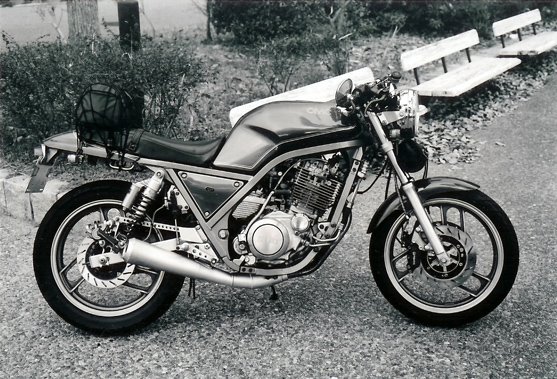
Akira arrives at about 9 o’clock, riding an immense Harley-Davidson FXDP 'Defender' instead of his usual Yamaha SRX cafĂ©-racer. The final P on the serial type stands for ‘Police’ -- this is no ordinary ‘hog’ but a full-blown California Highway Patrol specification 88-cubic inch machine, equipped with siren and full red/blue front-end lights for flashing at people. It is built for high speed pursuit of villains and has solid rubber tyres which cannot be punctured by gunfire. To comply with the law, the siren has been disconnected and the lights cannot be flashed, otherwise it is petty much the pukka item. Akira promises me that I can have a go on it at some point over the weekend, but not just now as we have to meet the other members of our tour group, which involves a bit of heavy traffic.


At 10 o’clock we are having a coffee at Akashi Service Area and talking to the owner of the H-D, one Mr Fujita. He has owned this remarkable machine for a couple of years but never gets time to ride it, so he has decided to sell it. This tour is a good way of showing it off to potential buyers. Today Mr Fujita is riding an ancient machine which must be about 50 years old, a 250 cc single-cylinder Meguro, which was the cash-strapped company that Kawasaki Heavy Industries purchased for its know-how when they decided to enter the motorcycle industry, at the beginning of the sixties.


He casts admiring glances at my machine, which is a modern version of the first ‘big bike’ that Kawasaki produced. Three of the other four riders are on various BMW models, two of them traditional ‘boxer’ twins and one old K-series which has an in-line 3 cylinder car-like motor. The final rider sits astride a Honda CB 1300—a very serious piece of kit with a custom titanum exhaust system.

We depart at quarter past ten down the Kakogawa by-pass, which must be one of the most dangerous roads in the world, and try to stick together in staggered formation. After about forty unpleasant minutes we are pleased to be off this road and head on down the valley of the Ibo river towards the Harima seaside road. The Meguro begins to slow down and we all pass it, finally pulling up about half a kilometer later when we realise it has stopped. Akira and the ride captain go back to see what has happened and the rest of us dismount and I get to know them all a little better. I suppose the best way to describe us all is as middle-aged hooligans, who had motorcycles when younger because they were cheaper to run than cars, but have now gone back to them because they really are the only way to really travel and make ‘good’ time, in the best tradition of Robert M. Pirsig.

“...Plans are deliberately indefinite, more to travel than to arrive anywhere. Secondary roads are preferred. Paved country roads are the best, state highways are next, Freeways are the worst. We want to make good time, but for us now this is measured with the emphasis on ‘good’ rather than ‘time’ and when you make that shift in emphasis the whole approach changes. Twisting hilly roads are long in terms of seconds but are much more enjoyable on a cycle where you bank into turns and don’t get swung from side to side in any compartment. Roads with little traffic are more enjoyable, as well as safer. Roads free of drive-ins and billboards are better, roads where groves and meadows and orchards and lawns come almost to the shoulder, where kids wave to you when you ride by, where people look from their porches to see who it is, where when you stop to ask for directions or information the answer tends to be longer than you want rather than short, where people ask where you’re from and how long you’ve been riding...”

We hear the throaty rumble of the Harley V-twin and the three riders approach, thumbs up indicating problem over. Our next stop is at a promontory called Man-Yo Misaki overlooking the Inland Sea.


Akira explains that the Meguro was suffering from a loose electrical connection, which was easily sorted out. As there is little traffic on the Harima Seaside Road, he suggests that the next stage, as far as the town of Hinase, will be a good time for me to try out the Harley. He warns me to be careful of its bulk as it weighs nearly twice as much as my Kawasaki.

I seat myself in the wide tractor-like single saddle, heave it upright and flick back the side-stand. It is very heavy and I struggle to get it in a position to start the engine. I take a minute to check out the unfamiliar control layout as the rest of the group depart. The left hand filler cap of the famous ‘twin’ tank is in fact a dummy, doubling as a gas gauge. There are separate left-right direction indicators on each end of the high-set bars, separate light switches for the headlight and pursuit lamps, a horn and a kill-switch and a starter button. I switch on the ignition and press the starter--but nothing happens which is somewhat disconcerting. I check everything and try it again and again, trying to remember what Akira said, feeling more and more foolish as the minutes tick by, until Akira and Mr Fujita appear. ‘Clutch!’ he yells, glaring at me through his full-face Shoei.

Ah--that was it. Silly boy, the devil is all in the details…

I depress the clutch lever, push the starter and the huge mill rumbles into life. Getting it down the winding track back to the main road is somewhat entertaining as my left boot is not used to the strange toe-heel action of the gear lever, and the weight of the thing is fearsome, just as Akira warned.

Once on the open road, it does not appear to need gears at all with the immense torque that the Milwaukee V-twin mill has. We pick up speed and the whole feeling changes. The bike is very well-balanced and is particularly nimble through the curves, which is surprising. I keep up with the ride captain with very little effort, a relief after the initial feelings of terror. A most amazing motorcycle.

I recall a conversation I had some time back, on the Akashi ferry with three very tidy leather-clad young ladies who all owned Harley-Davidson Sportster machines.
‘Why do you choose the Harley over Japanese bikes? They are very expensive...’
They thought for a moment and came back with the reply -- ‘Harley has soul...’.
At the time I thought it was just a cute bit of marketing by the H-D corporation, but now I am beginning to understand what they were on about. Yowza, what a rush. My mind begins to entertain improbable and immoral fantasies about buying this particular machine.

At the town of Hinase we stop for lunch, which is a welcome break. I have anago teishoku which is a local delicacy based on conger eel. I mention that the Japanese anago is of a size not much bigger than the normal river eel, but in British coastal waters the things grow to a formidable size, the world record being a female specimen caught off the West Country which weighed in at 62 kilograms and then some. One of the reasons is the large number of wrecks which litter the sea bed due to two bouts of submarine warfare in the 20th century, which provide welcome habitat for them. My banter is regarded as a fisherman’s tall tale at first, but Akira assures them that I am telling the truth. He has seen the evidence…


After lunch, Mr Fujita asks me what I think of the Harley and recommends that I stay on it to enjoy the high speeds of the Okayama ‘Blue Line’ which is a scenic route like the Ban-Tan. I accept his offer, partly out of the desire not to appear wimpish. It is a bit of a handful…

However, before getting to the Blue Line we have to get out of Hinase, which involves a lot of low-speed traffic and the Harley is not good at this kind of thing, nor at the narrow country roads which follow. Once we are on the Blue Line the Milwaukee iron comes into its own again, but at the Ippon-Matsu service area I almost beg Akira to take charge of it again. It is just too much work most of the time and there are not enough roads in Japan where it can be enjoyed at its best. I tell Mr Fujita ‘Thanks--but No Thanks’ and he gives me a wry grin of understanding.

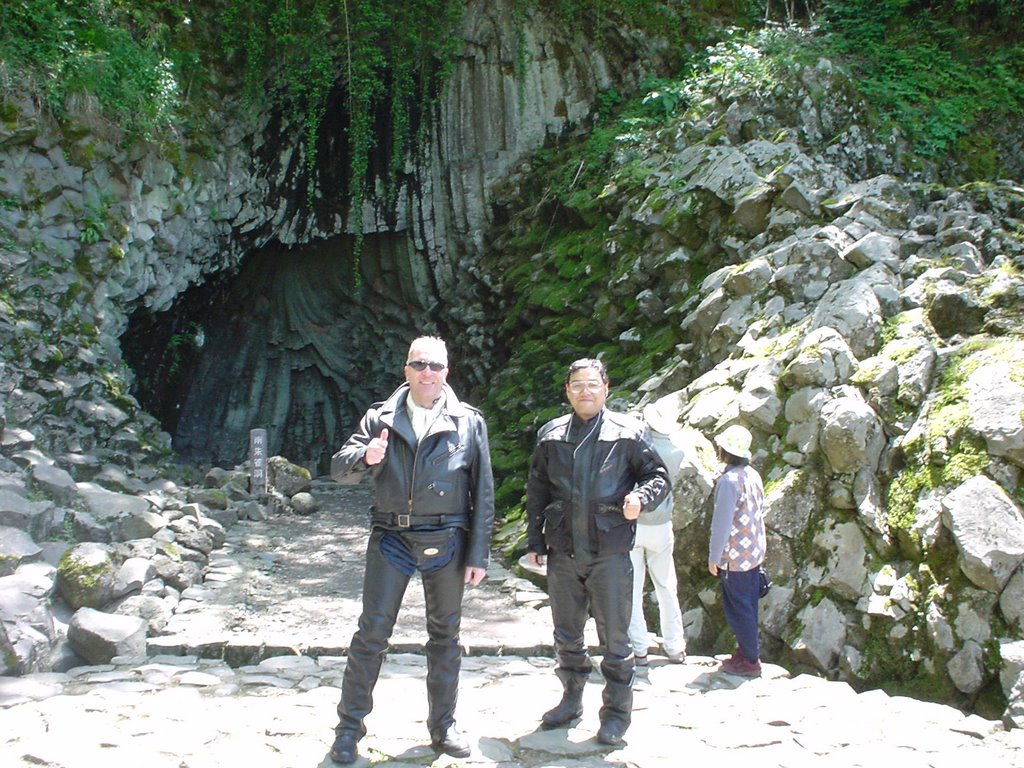
After this we leave the coast and head into the heartland of Okayama, which is aptly named as Hill-Mountain with its spectacular scenery. Before arrival at our destination we stop for a break at a roadhouse. After a while we attempt to set off again, but Mr Fujita finds that the kick-start lever has jammed on the Meguro, necessitating a push and bump-start. I begin to wonder at the risks involved in bringing such an ancient machine on a tour like this. Later on, the Meguro is repaired again, by Akira, with onlooker's commentary and unhelpful hints. Some things are the same the world over…


The lodge we are staying at is in a gorgeous bucolic location encircled by greenery, and has plenty of customers this day with about thirty members of the Kansai BMW owner’s club in attendance, as well as our group. The evening sees a sumptuous meaty barbecue of Yagyu beef and simply loads of bottled Asahi beer which gets everyone in a good mood, lots of good craic going on. I am well pleased that I came on this trip, having made lots of new friends.

The next day starts early with a traditional breakfast of rice, fish, miso and pickles. I take a post-prandial stroll outside and check out some of the views.


At 10 o’clock two members of the Mimasaka Fire Brigade show up and give some of us a lecture/demonstration of Cardio-Pulmonary Resuscitation and also the use of the Artificial External Defibrillator device, in case we ever come across an emergency situation at the roadside. I hope I never have to use the knowledge I have gained, but it is another reason to be pleased I came along.

After lunch Akira and I set off along Route 429 which crosses the spectacular Shibiki Toge pass back into Hyogo Prefecture. It is simply some of the best motorcycling I have ever done, in fabulous scenery and I resolve to come back and do it again some time. Unforgettable…


We stop for a break at Ichinomiya Onsen while we wait for Mr Fujita and the others, who set off earlier in the day to tour southern Tottori. They experienced the emergency treatment lecture last year. The hot-spring water is soothing to tired muscles and minds and we have a good soak and chew of the fat in the outdoor rotenburo bath, putting the world to rights. The water is salty, not as harsh as sea-water but definitely saline. We are miles from the ocean; there must be halite in the rock strata that the spring water percolates through.

When our companions finally turn up, somewhat later than expected, Mr Fujita is riding pillion with the ride captain. The Meguro has finally given up the ghost with a clogged carburettor and has had to be abandoned back up the road, for later retrieval and repair. Mr Fujita tells me his next move is to buy a Kawasaki W650 like mine. He has fallen in love with Black Mariah. Been there and done that mate...

We finish the day in our traditional manner, over ramen noodles and kara-age chicken, plus some gyoza dumplings which are the speciality of the road-house chain.

We have done over a thousand kilometers in less than a month, which means that Black Mariah is presently off the road, waiting for a new Dunlop TT 100 to be fitted to her rear end. This will be the third time for this exercise, at just over 24,000 km on the clock.

Many more happy trails lie ahead, I am sure. She has adequately filled the hole left in my life left by having to give up kendo. I'll be back…

Saturday, May 05, 2007

The Motorcycle Diaries part III

-- Over To the Fourth Country --

Golden Week is here again and our dromomaniac motorcycling tendency along with it. This year we have decided to have a crack at Muroto Misaki in Kochi prefecture on the island of Shikoku, the smallest of the four main islands in the Japanese archipelago. The ‘fourth country’ is a liberal translation of the name Shikoku. I spent the first two and a half years of my married life on Shikoku, but that was in Matsuyama in Ehime Prefecture at the western end of the island. Kochi Prefecture straddles the southern portion with its gorgeous sweep of Tosa Wan and the capes at each end of it, Ashizuri Misaki to the west and Muroto Misaki to the east. When we lived there, Shikoku was not connected by bridge to the main island of Honshu and there were no expressways so a 360 cc twin-cylinder two-stroke van with a top-end of 65 kph was quite adequate transport.

How times change. In the short space of a quarter-century three bridge systems have been built linking Honshu and Shikoku and once over there, a choice of three expressways awaits the intrepid road user.
Our journey begins at 8:15 on April 29th, a national holiday celebrating the late Showa Emperor’s birthday. It used to be known as ‘Green Day’ for some reason and the plans to resurrect the former name were a topic of bitter debate for some time in the National Diet. Something about reference to the Pacific War, it seems.…
This year it is a Sunday so ‘Showa Day’ is actually the following day, given as a holiday in lieu to make up the ‘Golden Week’.
The weather is warm and bright and we are swiftly down to Tarumi Junction and its masses of grey concrete which make up the approach routes to the Akashi Straits Bridge. With its centre span of 1991 meters this is currently the world’s largest suspension bridge and it certainly feels like it as we accelerate up the ramp and feel a fairly stiff crosswind blowing up out of the Inland Sea.


Due to the high toll fee, I don’t normally use the bridge unless it is to show it off to someone who has never seen it, and then only to the first service station/exit at Iwaya. However, we have our sights further afield this year and go straight on past, down the two-lane blacktop at a steady hundred and ten kph. Black Mariah is turning over at about 4000 rpm at this speed and she feels relaxed, with plenty of poke in reserve if necessary. We have spectacular views of Osaka Wan on our left and then as the highway cuts across to the west of Awaji island, equally spectacular views of the azure Seito Naikai, dotted with little fishing vessels. As we approach the mountainous southern end of Awaji, I notice four or five large wind turbines in rotation, making use of the almost constant airstream.

Before we know it we are off Awaji and crossing the Naruto Bridge onto Shikoku and Tokushima Prefecture and before very much longer we have paid our tolls at Naruto Interchange and have pulled up at a Lawsons combini for some caffeine nourishment. I feel a twinge of pain in my back and shoulders and realize that sustained high-speed riding on an un-faired ‘naked’ motorcycle involves considerable physical input. The canned coffee goes down well and we go outside to check the machines. Readers of this blog will recall that last year, our first stop came along with the realization that Akira’s Yamaha had an intermittent fuel leak which was not a welcome development at that stage. No such trouble this year as since that time, the machine has undergone major overhaul work, involving a rebore and head skim/valve grind, carburettor purge and fitting of an industrial-strength oil-cooler in engineer’s blue. The two bikes draw admiring glances from jealous car-drivers. They are _cool_ I must admit...


Then it is off into fairly heavy traffic on a four-lane road leading into and through the city of Tokushima. There is no margin for error as buses, trucks taxis and private cars jockey for position, switching lanes at will. Fortunately, our way to the south on Route 55 is well sign-posted and requires no right or left turns as it proceeds directly through the heart of the city. We are soon across the Katsuura River and the traffic thins considerably as the landscape changes, from commercial outlets and fast-food joints to flooded rice paddies with sparse green shoots of transplanted rice poking through the muddy water like whiskers on a teenage chin. Sometimes we pass a farmer hard at work on his rice transplanter machine, a most weird-looking tractor-like device with high ground clearance and skinny cast wheels, laden with trays of rice shoots. Also, flying proudly from many farmhouse buildings are the gorgeous koi-nobori, the carp streamers which indicate that there are children in the household. Always good to see, these bits of eye-candy form an essential part of the Japanese springtime experience.


As we approach the town of A-Nan I notice three immense, towering, tripod smokestacks and wonder what kind of facility they serve. The road takes a sharp detour to go around the industrial estate and it turns out that they are part of a power generation plant, all battleship-grey steel and dark brown ceramic insulators. There is no smoke emanating today, but the whole place has a sinister cast to it and I am pleased to be away from it as the land begins to rise.

We have picked up a travelling companion clad in natty leathers, riding a very smart Honda CB400 tricked out in streetfighter style. We have fun dicing it with each other through a series of ascending curves and then down the other side through the small town of Mi-Nami to follow a single-track railway to the town of Mu-Gi. The lad on the Honda takes his leave of us here with a cheery wave and we do not see him again.
Now I can smell the sea, or rather the Pacific Ocean, and we soon catch sight of it as the road hugs the coast winding past a series of spectacular inlets, with basaltic grey sandy beaches. It is a lovely road for motorcycles and I begin to feel a deep sense of relaxation and oneness with the universe.

I am rather harshly reminded that relaxing on two wheels is never a good idea, when one of my bĂȘtes noires -- a farmer in a small white pick-up, suddenly pulls out in front of me, gabbling into a mobile and puffing on a gasper, true to form. He gets a sustained blast on the klaxon and rude signs with the fingers as I overtake, but continues on his way oblivious as we enter Kochi Prefecture, tossing the fag-end out in the slipstream for good measure. What a prat...

From here down to the cape the road is blissfully quiet with very little traffic, apart from the odd bus or like-minded motorcyclist. I begin to see signs written in katakana phonetic script advertising something called hoe-ru uotchingu and wonder what on earth it can be. Then I see a water spout a few hundred yards offshore followed by a grey-black humped shape and finally the tail fluke of a surfacing whale. Whale-watching for tourists has now replaced killing them for food and profit in this area. Kochi was at the centre of the Japan whaling industry until the IWC moratorium a quarter-century ago. There have recently been calls from some sources to re-establish commercial whaling as there is evidence that some species like the minke have recovered their numbers sufficiently to sustain it. These calls are countered by shrill opposition which to my mind is more based on emotion than logic. The reality is that when whale meat was seen as a cheap and invaluable source of protein in the post-war decade, Japan was a country impoverished by its reckless charge into the Pacific War and its aftermath. Times have changed and no mistake. A whole generation has grown up never knowing the taste of whale meat. Japan can afford to import anything it wants nowadays. I have tried whale meat just once and was not impressed with its oily texture. I am pretty sure that any attempt to re-establish commercial whaling as a going concern will be doomed to failure, on the grounds that there is no market for the meat, apart from as dog-food which would be disgraceful. No-one in their right mind would choose oily whale over juicy Australian or US beef.
I am tempted to stop and watch the whale myself but the cetacean is moving away from the coast and is soon lost from view.

We round the final bend and a sign announces our arrival at destination. I insist on a photo as proof.


There is but one place to eat, so we go in there and enjoy spaghetti bolognese which is not bad. After repast we take a walk on the rocky shore. Akira comments that the scenery is exactly the same as on the other side of the Pacific in California. I decide to estimate where old Hernando must have sat in Panama to inspire the words of John Keats.

Or like stout Cortez, when with eagle eyes
He star'd at the Pacific - and all his men
Look'd at each other with a wild surmise -
Silent, upon a peak in Darien.


Afterwards, we remount and set off on the return journey. We have been studying the map and it looks like Route 193 will provide an interesting detour on the way back to Tokushima. This involves retracing our path as far as Awakainan, where the farmer nearly got me, and then turning left up the valley of the Umibe river.

At first this seems like a great idea, for about half an hour we are haring along a deserted winding country road with a great surface and gorgeous mountain and mixed-deciduous forest views. However this soon comes to an end and the road narrows to almost a single track with passing places. It also begins to wend up wards through dense cedars and the available light is cut down sharply. We keep going,onward and upward with a short 10 km detour to take a look at a famous waterfall, the Todoroki Taki. Unfortunately there is hardly any water in it, making the experience feel a bit like the pub with no beer. By the time we get down from the mountain my shoulders and biceps are aching from the effort of controlling the Kawasaki at low speeds along narrow roads strewn with fallen rocks and my nerves are shot through with the terror of wobbling past sheer drops with no guard rail. We have been at it for about 105 minutes but have only covered about 50 km as the crow flies. Madness...

At the first hint of civilisation I locate a vending machine and quench my raging thirst. Akira says he’d like to do it again sometime...

If I wasn’t so tired I’d have a good mind to laughingly fell him with a right cross...

The next leg of the journey is considerably easier, along the winding course of the Naka River in valleys of deep green. There is not much water in it though, and a considerable amount of silt deposits. In a few places hydraulic excavators made by the company that employs us both are at work in attempts to dig out the watercourse. Maybe they are going to dump the silt in the sea, where it really belongs. We soon see the reason for all this -- a dam. This is a problem which is becoming more and more evident each passing year. There is only one river in all of Japan which does not have a single dam along its course, which is a real shame. That fortunate water course is the Shimanto-gawa in southern Kochi Prefecture. I’d like to see it some day but there has been no time this trip. The state of the other rivers is no dam good at all...

At dusk we pull off the road in the township of Uragawa, to have dinner at a roadhouse. This comes in the form of miso-ramen and deep-fried kara-age chicken and has never been so welcome. Hunger is definitely the best seasoning of all, and no mistake.

After retracing our course through the neon-bright city of Tokushima and back over the bridges along the expressway to ‘our’ island, I bid goodbye to Akira. As I pull up outside our house at 21:15, I check the odometer. 13 hours and 570 kilometers is a new single day record for me--and it feels like it. It surely does...

Epilogue:
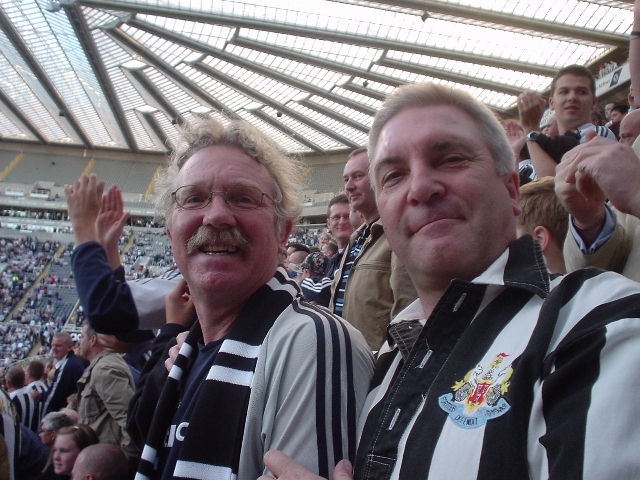
Newcastle United are slouching to a miserable mediocre mid-table position in the Premier League, looking likely to finish with a record low points total for the club. The end of the season 2006 – 7 can’t come quickly enough for me. At least there will be derby games with the Mackems next season as Sunderland are guaranteed promotion either as Championship champions or runners-up. All I can do is pray for more scoreboards like this...

Wednesday, April 04, 2007

Sakura, Sakura...

Cherry blossom is everywhere now, at least in Western Japan. Always a welcome sight, letting us know that Spring has truly arrived. We had a slight cold snap after my last blog entry on March 4th, reminding me that the old saying of ‘Ne’er cast a clout, till May be out’ should be modified to ‘… till March is out’ to suit the climate of Japan. This does show us that the world was indeed a colder place in 1732 , when the saying was coined. There is some dispute as to whether May refers to the 5th month or to the May tree or hawthorn, which blooms in late April, but in either case if you leave your winter woolies on that long you are going to be somewhat sweaty. Another, less welcome harbinger of Spring is the phenomenon of kohsa, or fine yellow sand loess borne on the prevailing wind from the Yellow River region of mainland China. It makes formerly clear views very hazy and settles everywhere, making freshly washed cars look dirty. Perhaps the Three Gorges dam will make a difference by irrigating desert areas, but I doubt it. For those who suffer from it, this is also the season of kafunshoh, or pollen allergy, a condition similar to hay fever. The main culprit is the cedar tree, which is found everywhere in Japan in vast monoculture forests. These were planted as part of a post-war government scheme to become self-sufficient in timber for construction purposes, displacing the natural mixed-deciduous forests to a large extent. As millions of households had been destroyed by American bombing during the Pacific war, this would seem to have been a sensible policy. However, no-one foresaw the vast boom in Japan’s GDP and the gradual appreciation of the yen vs the dollar that was coming. As a result, it is cheaper to import lumber from North America and the domestic industry can hardly be described as a going concern. Most of the labour force are close to retirement age and lumber is not an attractive proposition for the young techie generation, along with agriculture in general. So the cedar trees stand uncut on the hills and mountains in serried ranks, giving off pollen by the bucketful in Spring to irritate the eyes and noses of sufferers. It even affected me to a certain extent last year, bringing on sneezing fits two or three times a day. So far in 2007, I have been OK but there is a way to go yet. I did hear that some enterprising botanical researcher had developed a kind of vaccine for the cedar tree which will suppress its pollen-producing tendency, but the size of the task in inoculating each individual tree must beggar belief.

Last time I blogged I was hopeful that Newcastle United were going to bring some joy to their long-suffering supporters and get into the last eight of the UEFA Cup. They started off well enough on March 8th, beating the Dutch side AZ Alkmaar by four goals to two at SJP in the first leg. Surely, we all thought, surely they can defend a two-goal lead next Thursday. Well, they could not, going down 2-0 to allow AZ the passage on the away goals rule. Since then, they have lost twice in the League, 2-0 away at Charlton Athletic and 0-1 to Manchester City at home last Saturday. This latest reversal has seen the fans turn against the manager and chairman in great numbers. One man marched onto the pitch and tore the remainder of his season ticket to shreds in front of the dug-out. Another did the same thing with his replica team shirt, not a cheap item. Some people take the fortunes of their team very seriously indeed. To make matters worse, the rival team Sunderland have been sweeping all before them and are now being given odds of 1-2 for promotion to the Premier League. It is not the best of times to be a Toon supporter, but (according to The Sporting Life) the club have just announced plans to increase the capacity of SJP to more than 60,000 along with some very posh housing development as part of a £300-million development scheme, at almost the same time as announcing an operating loss of £6.9 million, mainly due to inept player trading and amortisation. All of this will be done by ‘external financing’ and is still subject to official approval. They are obviously looking into a rosy-pink crystal ball or they are on some wondrous kind of hallucinogenic.

‘... But who has won? … At last the Dodo said “Everybody has won and all must have prizes...’

The Six Nations Championship turned out to be a kind of Lewis Carrollian caucus race in the end, with the Frenchies nicking it at the death by 3 points but every team ended up with something to shout about, even the wooden spoon men, Scotland. All good stuff and a good advert for the noble ‘game for hooligans played by gentlemen’.

England are in the Super Eight stage of the Cricket World Cup, being contested in the West Indies. Having won one and lost one match, they are being given odds of 14-1 to win outright. On the other hand Australia are at 11-10. I think the bookies know what they are doing... However, the series has been overshadowed by the murder of the Pakistan coach, Bob Woolmer, after they were eliminated from the competition by Ireland, not normally thought of as a cricketing powerhouse. There is heavy suspicion that a gambling syndicate were involved, possibly because the dead man was about to blow the whistle on a vast global match-fixing syndicate. A very dirty business, however you look at it.

Here in Japan, we have all been horrified by the grisly murder of a young English teacher, Lindsay Ann Hawker, in Ichikawa, near Tokyo. She was found naked and battered in a bathtub filled with sand on the balcony of an apartment inhabited by one Tatsuya Ichihashi, who is now the chief suspect. According to the reports he fled barefoot when the police came to the apartment, acting on a tip-off. Quite how he managed to evade capture is anyone’s guess, but he is still at large. Ichihashi is the one pictured left below. If you see him, please inform the police as to where and when. They really need to talk to him.

The most recent news is that the suspect Ichihashi was involved in the stalking of another female English teacher last year, whose complaints to the police fell on deaf ears. The young woman was sufficiently traumatized to quit both her job and the country. Unbelievable incompetence by Chiba’s finest. Sitting on their hands while a genuine threat was reported and allowing a barefoot suspect to get clean away. Shinjirarenai!
The unfortunate Lindsay appears to have been under the impression that Japan is a perfectly ‘safe’ country and there was no risk in going to the apartment of a total stranger to give him a private English lesson. Foolhardy, to say the least. Japan is quite ‘safe’ on the surface but there are dark undercurrents to the society which manifest themselves from time to time. Some five or six years ago, a British night-club hostess, one Lucie Blackman was murdered in similar fashion and then dismembered and dumped in a seaside cave, crudely encased in concrete. The trial of her alleged killer, one Joji Obara is still going on, though an official ruling is expected soon. Unfortunately, this latest terrible event has given the lower-end English tabloids (like The Sun) an excuse to print all sorts of garbage about how Japan is a nation packed with sadistic male perverts whose main jollies are got by humiliation and torture of women. I’m not saying that people like that don’t exist here but really, this is pretty rich stuff from a country which produced Peter Sutcliffe (the Yorkshire Ripper) and Dr Harold Shipman (Doctor Death)...

The words ‘glass houses’ and ‘throw stones’ spring readily to mind. Never let the facts get in the way of a good story...

I should try and finish on a cheerful note so it is with a glad heart that I note the ‘Prods’ and ‘Taigs’ of Ulster (Norn ’Iron) are finally in sight of a lasting agreement. Former bitter enemies, the DUP's ‘Reverend’ Ian Paisley and his Sinn Feinn counterpart, Gerry Adams have finally agreed on a devolution deal and will sit together in Stormont Castle starting May 8th.
To quote the good Reverend:

We must not allow our justified loathing of the horrors and tragedies of the past to become a barrier to creating a better and more stable future.

In looking to that future we must never forget those who have suffered during the dark period from which we are, please God, emerging.

We owe it to them to craft and build the best future possible and ensure there is genuine support for those who are still suffering.

Now that’s more like it lads! The Lion can lie down with the Lamb after all...
For some strange reason, I think it is really going to work this time. We shall see.

Monday, March 05, 2007

Early Spring

March the Fourth it is and about time I put something up on this blog. After all it’s supposed to be an abbreviation of web-log, implying something updated pretty regularly if not daily. A good excuse might be that this 17-inch G4 PowerBook was out of action from Dec 31st until last weekend--a period of about eight weeks. I was able to keep computing due to the generosity of my daughter, Aya, who sportingly allowed me to set up an account on her iBook and use it in the evenings and weekends--so it isn’t really a good excuse. No the real reason is simply that I’ve been overwhelmed with part-time work and have been kept busy up till about 22:00 every night since we came back from our New Year break in Kyushu. Just why I behave like this became apparent when my partner in this translation/proofreading/rewriting work came around with a chit for the taxman which showed that the PowerBook has paid for itself four times over with the work I’ve done on it since assuming ownership about a year ago. Mustn’t grumble then...
The reason why the machine was out of action so long came down to my fault in mis-diagnosing the problem. Once it was correctly diagnosed, the good folks at the Apple Store, Shinsaibashi, Osaka took it in for a week and restored it to health, simultaneously relieving me of the ¥en equivalent of about sixty-five quid for parts and labour. A learning experience--the nature of machines. They break sometimes and then it costs money to fix them.
The last time I blogged, just before Christmas, I was expressing hope that the England cricket team were going to turn themselves around and at least win one Test Match in the Ashes series. Well, enough said about that, though they did set a dubious kind of record in the least number of days a team has ever retained the hallowed trophy. To their credit, once the Ashes debacle was over they did record one victory over the Oz in a one-day international.
Then it was the turn of the England rugby team to set hearts a-flutter as they comprehensively demolished Scotland by forty-two points to twenty in the Calcutta Cup with the great Jonny Wilkinson scoring a record twenty-seven points in the course of the game. One try, two conversions, five penalties and a drop goal has a nice spread to it. That was on February 3rd at Twickenham and they were looking good for the Six Nations championship. Since then they have laboured to an unconvincing win over Italy and been well and truly turned over (43-13) by the Irish by at Croke Park. It was fitting in a way that the Irish should have won the fixture since the last time an English ‘team’ was at the venue in 1920, it was the Black-and-Tans (and the RIC and Auxiliaries) firing on the crowd and players at a Gaelic football match, killing fourteen unarmed civilians. This was in reprisal for the activities of Michael Collins and his ‘Twelve Apostles’ who had successfully assassinated fourteen English secret-servicemen and military intelligence officers (known as the Cairo Gang) earlier the same day.

I do hope that both nations can now move on from such frightful events, after eighty-seven years amd let bygones be bygones.

Whatever the poetic nature of the victory for the Irish, the scale of the loss for England has been devastating, particularly as our main weapon, the boot of Jonny Wilkinson, was kept very quiet all match. The latest news is that he has a hamstring injury, which is a bit unsettling as we take on France at Twickenham on March 11th. It will be a do-or die affair, particularly as Ireland will probably have clinched the Triple Crown the day before by beating Scotland.
Meanwhile, while all of this was going on, my main squeeze Newcastle United FC were quietly lifting themselves out of the relegation mire with a series of gritty performances, probably the best of which was against Liverpool at St James’ Park on February 10th, when Martins and Solano scored a goal each to win the game two-one. It was especially good after they had gone behind in the sixth minute to a soft goal gobbled up by Craig Bellamy (aka the Gob of Glamorgan) who was obliged to leave the Toon under a cloud a couple of seasons back. A frightful bounder, by all accounts, but a handy goal-poacher nevertheless.

As it stands Newcastle are in tenth place in the Premier League, exactly mid-table with a record of:

P 29 (Home) W7, D5, L3 F 23 A 17 (Away) W3, D2, L9 F 11 A 20 Pts 37 Goal diff -3

To be sure, I have seen a lot worse but it’s hardly the kind of stuff which inspires blind faith. All Geordie expectations are now on the UEFA Round of 16 which sees The Toon take on the Dutch side AZ Alkmaar at SJP on Thursday March 8th. The away fixture in The Netherlands is on the following Thursday. It is our only hope of any tinware this season and hopes are high, particularly as the injury list is showing signs of improvement. Even Michael Owen has been kicking a ball again. More to the point is the fact that the great rivals Sunderland AFC have hit a purple patch under Roy Keane and have taken 26 points from the last thirty to look very likely candidates for an early return to the Premiership. Bragging rights are at stake all across the North-East of England. In the unlikely event that we do win the thing it will be the first major trophy brought back since the halcyon days of 1969, when the competition was known as the Inter-Cities Fairs Cup.

Howay the Lads.

As for the family, my eldest son made us all proud by graduating from Nishinomiya Kofu High School last Saturday, while his younger brother made sure of his place at Amagasaki High School in late February. For some reason known only to himself, the cho-nan decided an appropriate way to celebrate graduation would be to dye his hair the colour of straw, which did not amuse his father very much. His appearance reminded me of Heinrich Hoffman’s character Struwwelpeter (Straw-headed Peter).

Ah well, boys will be boys, one more year of teens for him.

The weather is warming up fast and some of the first midges of the season met their untimely end on the face-shield of my Arai helmet on Sunday. Usually they don’t make an appearance till about April. It doesn’t bode well for the summer, be prepared for a scorcher...

Saturday, December 23, 2006

God rest ye merry gentlemen...

Saturday, December 23rd 2006
Two days till Christmas and might as well end up the year’s blogging on a cheerful note. Not that I ever celebrate Christmas very much any more. I only ever have December 25th off when it’s a Sunday; something which always comes as a surprise to the each year’s generation of students who always seem a little disappointed when I don’t go on about how I celebrate. Where I come from, the North of England, it always seemed to me that the New Year was a more important celebration--and that is the way it is in Japan.
In theory anyway. A walk down the road for the casual observer would see garish American-style outdoor illuminated decorations bedecking houses with reindeer, Santas, angels and holly, each household trying to outdo the other in how much power they can waste. It is an annual source of amazement to me, when less than 1% of the population are Christian. Of those, I think the majority are sober types like Methodists or Baptists for whom showy Christmas is not really part of the deal.
Since mid-November, the shopping malls have been similarly done out, with schmaltzy Yuletide tunes assaulting the ear at every turn. It’s nothing to do with Christ, but everything to do with Roman Saturnalia and the other pagan festivals which the early Christian missionaries felt it was convenient to adopt. The Yule log and decorated fir-tree from the Vikings, the mistletoe from the Druids, turkey from the Native Americans and so on. Very eclectic.
One part of it all that I’ve got no problem with is the notion of ‘Peace on Earth and Goodwill to all Men’. Would that it were true! There seems to be more strife now across the face of the globe than I can ever remember, but that’s maybe because I have access to more information now than I ever did before--thanks to broadband Internet access.
On Dec 28th, we will be on the road to Saga for about a week’s worth of doing very little. Sitting in the kotatsu and eating mikan oranges, I hope to catch up on some reading and to not go near a computer for the duration. We were going to leave on the 27th but my youngest son has to attend a special ceremony where he will be presented with the Kobe City 最ć„Ș秀遞手 (sai-yuu-shuu-sen-shu) award for 2006 aka the Blue Riband or MVP of sports, on account of his performances this year. It’s dog-with-two-tails time again...
In the New Year, I’ll be looking into the world of web-cams so we can see more of the family back home rather than just Skype-talking to them. I’ve been messing with a discarded Sony Digital Handycam to see if I could make that do the job of a web-cam, but alas, it has only a lowly USB connector and FireWire is what is needed.
In the meantime--all the best for ’07 to those who read this blog.
I’ll be back…
Wednesday, December 13, 2006

Birds of a feather...

One of the first things I remember about entering the University College of Wales in September 1973 was that people were getting very agitated about events in Chile. With good reason, as it turned out. At first reports were very unclear, sounding more like rumour and counter-rumour, but it soon became very clear that a disgraceful event had taken place. The democratically elected Chilean president Salvador Allende had been overthrown in a bloody coup d’etat, with the full complicity of the USA, merely because he was a socialist. It was led by Augusto Pinochet, who previously had been a trusted presidential aide, in charge of the military. Allende did not survive the coup, allegedly taking his own life. For the next 17 years Pinochet ruled Chile with an iron hand, establishing one of the longest lasting dictatorships in Latin America.
Who’s your Daddy?

He and his thuggish entourage soon revealed that they had little use for democracy, viciously crushing any opposition to their rule. This resulted in approximately 3000 people dead or were simply not there anymore. The verb ‘disappear’ was given a new transitive format. The 1977 ‘Operation Condor’ and the infamous ‘Caravan of Death’ were among the devices used to further his program of obliterating resistance. By 1990 he had been forced from office and spent the rest of his time among us deftly avoiding trial for his crimes against humanity, at the same time allegedly building up a hoard of ill-gotten gains in murky overseas accounts. He was incarcerated in Britain for about 18 months in the late 1990’s awaiting trial for human rights abuses, but finally managed to wriggle off the hook on the grounds his state of health had made him unfit to stand trial. One of his strongest defenders was the former UK Prime Minister, Margaret Hilda Thatcher, who argued that he was ‘a true friend’ to Britain thanks to his support during the Falklands War. It is my considered opinion that Thatcher showed her true colours at this time, and that we saw in Pinochet’s actions what she would have done to her opponents during her time in power, had she not been constrained by a parliamentary democracy.
Britain needs ‘true friends’ of Pinochet’s ilk like a collective hole in the head.

The evil old monster has now gone to his grave, without ever having to answer for his crimes. For some people, Pinochet was and remains a hero, on the grounds that he was strongly influenced by the Chicago School of Economics, using its tenets to ‘transform’ Chile into South America’s strongest economy.
Oh, I see, so that’s all right then...

Friday, December 08, 2006

What I did on my holidays and other ramblings...

Well, the last time The Cap'n blogged was just before the World Cup started in Germany and it was mainly ranting on about the enforced Budweiser sponsorship of the event. When the tournament got started I watched a lot of the action and lost a lot of sleep as a result. On the other hand, England never really got going and with hindsight were a major disappointment, from the final lachrymose crocked Beckham exit, to the hideous belligerence of Rooney, which almost certainly lost us the best shot we’ve had at the trophy in a long time. Penalty kicks are an awful way to go out and an even worse way to win the thing, which Italy finally managed to do after setting new standards of precipitously low gamesmanship and downright cheating when claiming fouls had been committed to garner free-kicks/penalties. From a Newcastle United supporter’s viewpoint, the worst sight was that of Michael Owen being carted off the pitch on a stretcher after playing less than 2 minutes of the Portugal match. It’s still not clear what happened, but I heard he was thinking of suing the German FA, on the grounds that the playing surface was uneven and not fit for a top-level match. Severe cruciate ligament damage means he is not expected to make a first-team appearance this season, in a squad decimated by injuries. I’ve certainly known better days as a Toon supporter and no mistake. However, as I write the reports are all of a 3-2 win over Reading last night, in a pulsating encounter at St. James’s Park which has eased the relegation worries, for a while anyway. The lads are unbeaten in 7 games and are a lowly 15th in the Premiership as they travel to Ewood Park, Blackburn to try and get a result.
The World Cup was no sooner over than we were off to dear old Blighty for our annual summer vacation. It is always a relief to escape from the stifling heat of Japan’s summer season and this year was no different. However, it marked the first time that my wife and I have travelled by air without the offspring, which felt a little odd at first. It is something we will have to get used to though, as they gain years and wisdom. My wife was only there for a week, being worried about leaving our daughter in charge of the boys for any longer than that. I was there for nineteen days and had a fine old time, even though the weather did not play its part all the time.
I did manage to get to St. James’s Park to see the black & whites take the field, treating my old friend Keith to his first view of the interior of the magnificent stadium.

As he is a Sunderland supporter (aka a Mackem) he had difficulty in saying anything at all positive about the home ground of his deadly rivals, but he did mutter some monosyllabic grunts to that effect. The opponents in a friendly game were Villareal of Spain and the ground was less than half-full, but I was determined to enjoy myself. Newcastle, though, did not seem to be up for the affair and went behind in the 13th minute to one of the softest goals I’ve ever seem them concede, gifted to Josico. Keith was most amused, of course, and began to pay close attention to the field of play. I was somewhat relieved when Ameobi powered a quite exquisite header into the top-right corner of the Leazes net on twenty-two minutes to level the score, but this feeling did not last long. Villareal were not to be denied and went in at the half leading two-one after more defensive dithering allowed Pires to net. The half-time pie was most excellent, far better they ever used to be, which almost put me in a better mood. Surely Glenn Roeder had something up his sleeve to turn the tide?
If he had, he kept it up there because we were floundering again just after the hour when Rodriguez rose unmarked in the Leazes penalty area to plant an unstoppable header past the helpless Shay Given. I began to question my sanity in forking over hard-earned specie to be ‘entertained’ in this manner but Keith was having the time of his life, chuckling away in a manner not seen for years. It all looked black for us until 15 minutes from the end when Roeder made an inspired substitution, bringing on Nicky Butt for the lacklustre Babayaro. Somehow Butty snatched respectability from a rout, by scoring twice in 2 minutes in front of the ecstatic Gallowgate crowd. The last ten minutes were almost worth the price of admission as both teams went for the kill, bringing fine saves at both ends of the pitch, but all-square was how it ended after the ninety minutes were up. Even Keith had good words to say, even though he had been denied the ammunition to bait me with for years to come. Funny old game is football...
One good thing about being at home on holiday without my immediate family was that I got to spend more time with my own mother and father than is usually possible. We had a couple of really good days out, even though the weather didn’t really play its part. One of these days was a trip across the Tees borderline into North Yorkshire, with the aim of catching a glimpse of the restored A4 Pacific class locomotive Sir Nigel Gresley in its new role pulling passenger trains on the scenic 18-mile route between Grosmont and Pickering. The A4 Pacific class with its streamlined bodywork is generally reckoned to be one of the most beautiful steam locomotives ever built, whether you are interested in them or not. One of my earliest memories is waking up with a sore throat after a tonsillectomy in Durham General Hospital. As the nurse threw back the curtains, one of these locomotives came hissing into Durham station across the viaduct, all billowing steam, polished brass and gorgeous green livery. Fantastic it was. I think it was the Mallard but I’m not sure. In 1937, the hundredth such locomotive to be built was named after its designer, honouring him before his death in 1941.

This gorgeous piece of kit was rescued from the knackers yard in 1966 and underwent extensive restoration work over many years, at great expense. When the website of the North Yorkshire Moors Railway informed me where Sir Nigel could be observed in 2006 my interest was fired up and we duly set off on the pilgrimage. The weather was fine as we left but it rapidly deteriorated and as we crossed the Tees into Yorkshire the whole countryside was thoroughly shrouded in grey gloom and drizzle. It was very nostalgic for me to be honest, Yorkshire is really like that most of the time which is why it is such a green county. We had decided to try and view the locomotive from the hamlet of Beck Hole in the valley of the River Murk Esk. Beck Hole was a popular spot with Victorian and Edwardian visitors and is halfway up one of the the steepest inclines on the rail network. The one in forty-nine gradient means the locomotives are really labouring at low revs, providing the deep, satisfying CHUFF - CHUFF- CHUFF sound so beloved of live steam enthusiasts.
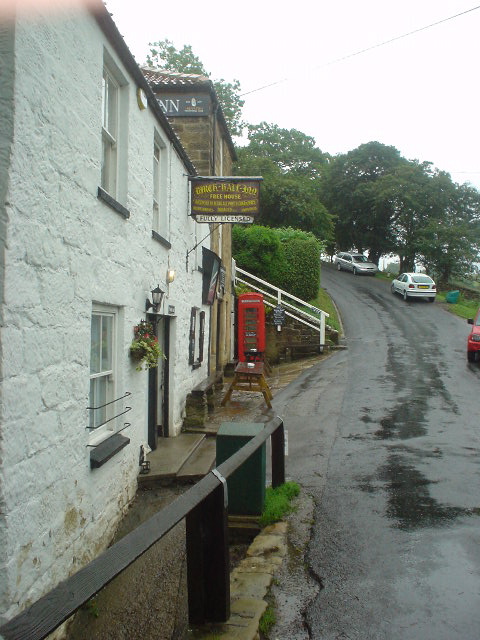
As it happened we had some time to kill before the next scheduled Pickering - Grosmont run of Sir Nigel so we went for refreshment in one of the smallest pubs I have ever been in.

The bar was full of smokers so we went in the lounge, my mother, father and I, meaning that it was really crowded. The man in charge entertained us with some ancient photographs of Beck Hole and the pub in days gone by. A nice pint of Theakston’s for me and a pot of tea for Mam & Dad had us suitably fortified and about half an hour later we drove the car up to the arch bridge to wait for our rendezvous.
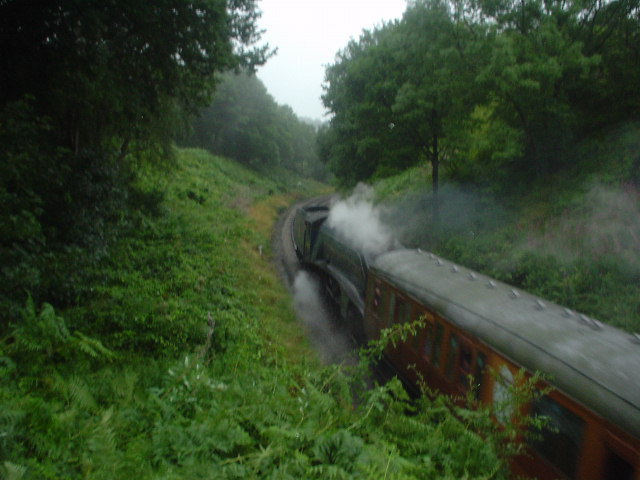
When Sir Nigel arrived (late--some things never change) I was a little dismayed to find the tender was leading with the loco pulling the train in reverse, so the shot I had been anticipating did not quite materialize.

What I had been hoping for was something like this:

The best-laid schemes of mice and men, gang aft a-gley, as I’ve noted before. Never mind. The NYMR do put on a Sunday lunch service on the trains which sounds like a good idea for our 2007 excursion, though we would need better weather to make it worthwhile.
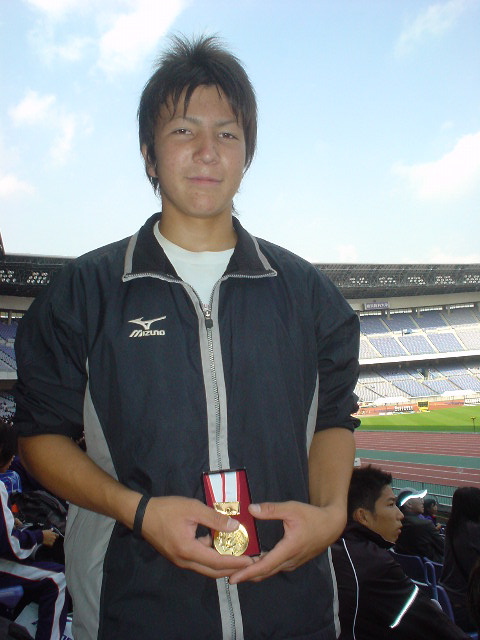
On return to Japan, I was almost immediately whisked off to the island of Shikoku, to the city of Marugame in Kagawa Prefecture. The reason for this was that my youngest son, Genki, was representing Hyogo Prefecture in the All-Japan Track & Field Championships, taking part in the shot-put event. In the end he managed a very creditable 4th place, but there was a considerable distance between the top 3 and his best effort. Shot-put involves body-weight above all and he simply does not have the bulky frame to excel at it. Nevertheless we were very pleased and very proud of his efforts, all the while hoping he would heed the advice of his coach and concentrate on discus. Two months later all dreams came true when on October 27th he took the gold medal in the discus event of the so-called ‘Junior Olympics’ at Yokohama International Stadium.

Wow. Dat’s ma boy! Numero Uno! At first he looked a bit wobbly as his first practice throw nearly hit the line-judge, while the second almost landed on the running track. Fortunately, there was no race in progress at the time. When time came for his first throw proper it flew far and straight in a perfect spinning arc, to touch down at 54.70 metres, fully 2 metres further than his previous best and bettering his great rival from Kyoto by a metre and a half. I swear I could feel the latter’s ego deflating as he contemplated the mountain he had to climb. At close of play, no-one had bettered 54.70 and so he stood proud on the podium like a dog with two tails, his previous rival taking the bronze.

One of the first entries in this blog was a report on the 2005 Ashes Test series victory by England, which was most gratifying to write. 14 months later, the series is taking place in Australia and England trail by 2 matches to nil, after a second innings batting collapse in the 2nd Test deflated our hopes of a come-back. We were beaten out of sight in the 1st Test, no mistake about it. It doesn’t bode well for a retention of the odd little urn that is the trophy, which allegedly contains the ashes of the cremated bats, balls and stumps from the first time Australia beat England at cricket, in the late 19th century. However, all is not over till the Fat Lady sings and the Third Test begins on December 14th in Perth at 02.30 GMT. I’m hoping the Three Lions on a shirt can prevail, otherwise it’ll be a pretty gloomy end to 2006.
I hope 2007 will see me blogging a bit more regularly. All the best for the season!

Sunday, June 11, 2006

The World's Worst Beer?


In the run-up to the World Cup in Germany this week, I noticed something in the news about the official beer for the event being Budweiser. Moreover, it’s not even the original Budweiser from what was Czechoslovakia, but that insipid, watery excuse for a beer made by Anheuser-Busch of St Louis. Apparently, this American mega-corporation have ponied up $47 million as one of the official sponsors, giving them the right to make Bud the only beer on sale within a 500 metre radius surrounding the official stadiums. As a sap to the Czech brewery of Budweiser Budvar, Anheuser-Busch are only allowed to advertise their product as ‘Bud’.

The German reaction has been predictable.

‘I wouldn't wash my car with it,’ said Bavarian Beer Club member Ottmar Riesing.
‘We have a duty to public welfare and must not poison visitors to World Cup venues,’ said Franz Maget, leader of the Bavarian Social Democratic Party, commenting on what some Germans have called ‘beer censorship’.
The same man called Bud ‘the world's worst beer’ and he could be right, even though by his country’s standards it is _not_ beer at all, but something else.
Advertising Bud as ‘beer’ contravenes the German version of the Trade Descriptions Act. The German purity law only considers a drink to be beer if it is brewed from malt, hops and water and Bud is looked down upon by those familiar with Germany's storied tradition of beer because it is produced with rice included in its ingredients.
However, FIFA are standing firm, which gives the verity to what Bob Dylan penned all those years ago--‘Money doesn’t talk--it swears’.

All this reminds me of a dispute in Britain over thirty years ago concerning ‘Real Ale’ versus ‘keg beer’. A consumer association called CAMRA (Campaign for Real Ale’ was set up in 1971 in protest at the brewing industry producing pasteurised beer served chilled from kegs pressurised with CO2 or nitrogen. Aggressive merger and acquisition tactics meant that many small breweries producing traditional cask ales were disappearing. I prefer cask over keg anyday and I was and am generally in favour of the activities of CAMRA

It must be said though, that keg beers have improved immeasurably over the years. Moreover, there is nothing worse than having your ear bent by an over-enthusiastic CAMRA auto-didact, while you are just trying to enjoy a quiet pint.
In the sixties one of the bete noirs of CAMRA was an abominable beer called Watney’s Red Barrel, which is no longer in production. Its demise was surely helped by a Monty Python sketch broadcast in November 1972 featuring a dialogue between Mr Bounder of Adventure Travel (Michael Palin) and a tourist called Mr Smoke-Too-Much (Eric Idle). It was enough to put anyone off for life!


… Bounder: Anyway about the holiday

Tourist: Well I saw your adverts in the paper and I've been on package tours several times you see, and I decided that this was for me

Bounder: Ah good

Tourist: Yes I quite agree I mean what's the point of being treated like sheep. What's the pointof going abroad if you're just another tourist carted around in buses surrounded by sweaty mindless oafs from Kettering and Coventry in their cloth caps and their cardigans and their transistor radios and their Sunday Mirrors, complaining about the tea - "Oh they don't make it properly here, do they, not like at home" - and stopping at Majorcan bodegas selling fish and chips and Watney's Red Barrel and calamares and two veg and sitting in their cotton frocks squirting Timothy White's suncream all over their puffy raw swollen purulent flesh 'cos they "overdid it on the first day."

Bounder: (agreeing patiently) Yes absolutely, yes I quite agree...

Tourist: And being herded into endless Hotel Miramars and Bellvueses and Continentales with their modern international luxury roomettes and draught Red Barrel and swimming pools full of fat German businessmen pretending they're acrobats forming pyramids and frightening the children and barging into queues and if you're not at your table spot on seven you miss the bowl of Campbell's Cream of Mushroom soup, the first item on the menu of International Cuisine, and every Thursday night the hotel has a bloody cabaret in the bar, featuring a tiny emaciated dago with nine-inch hips and some bloated fat tart with her hair brylcreemed down and a big arse presenting Flamenco for Foreigners.

Bounder: (beginning to get fed up) Yes, yes now......

Tourist: And then some adenoidal typists from Birmingham with flabby white legs and diarrhoea trying to pick up hairy bandy-legged wop waiters called Manuel and once a week there's an excursion to the local Roman Remains to buy cherryade and melted ice cream and bleeding Watney's Red Barrel and one evening you visit the so called typical restaurant with local colour and atmosphere and you sit next to a party from Rhyl who keep singing "Torremolinos, torremolinos" and complaining about the food - "It's so greasy isn't it?" - and you get cornered by some drunken greengrocer from Luton with an Instamatic camera and Dr. Scholl sandals and last Tuesday's Daily Express and he drones on and on about how Mr. Smith should be running this country and how many languages Enoch Pow ell can speak and then he throws up over the Cuba Libres.

Bounder: Will you be quiet please

Tourist: And sending tinted postcards of places they don't realise they haven't even visited to "All at number 22, weather wonderful, our room is marked with an 'X'.

Bounder: Shut up

Tourist: Food very greasy but we've found a charming little local place hidden away in the back streets

Bounder: Shut up!

Tourist: where they serve Watney's Red Barrel and cheese and onion.......

Bounder: Shut up your bloody gob....

Tourist: crisps and the accordionist plays 'Maybe it's because I'm a Londoner'." And spending four days on the tarmac at Luton airport on a five-day package tour with nothing to eat but dried BEA-type sandwiches and you can't even get a drink of Watney's Red Barrel because you're still in England and the bloody bar closes every time you're thirsty and there's nowhere to sleep and the kids are crying and vomiting and breaking the plastic ash-trays and they keep telling you it'll only be another hour although your plane is still in Iceland and has to take some Swedes to Yugoslavia before it can load you up at 3 a.m. in the bloody morning and you sit on the tarmac till six because of "unforeseen difficulties", i.e. the permanent strike of Air Traffic Control in Paris - and nobody can go to the lavatory until you take off at 8, and when you get to Malaga airport everybody's swallowing "enterovioform" and queuing for the toilets and queuing for the armed customs officers, and queuing for the bloody bus that isn't there to take you to the hotel that hasn't yet been finished. And when you finally get to the half-built Algerian ruin called the Hotel del Sol by paying half your holiday money to a licensed bandit in a taxi you find there's no water in the pool, there's no water in the taps, there's no water in the bog and there's only a bleeding lizard in the bidet. And half the rooms are double booked and you can't sleep anyway because of the permanent twenty-four-hour drilling of the foundations of the hotel next door - and you're plagues by appalling apprentice chemists from Ealing pretending to be hippies, and middle-class stockbrokers' wives busily buying identical holiday villas in suburban development plots just like Esher, in case the Labour government gets in again, and fat American matrons with sloppy-buttocks and Hawaiian-patterned ski pants looking for any mulatto male who can keep it up long enough when they finally let it all flop out. And the Spanish Tourist Board promises you that the raging cholera epidemic is merely a case of mild Spanish tummy, like the previous outbreak of Spanish tummy in 1660 which killed half London and decimated Europe - and meanwhile the bloody Guardia are busy arresting sixteen-year-olds for kissing in the streets and shooting anyone under nineteen who doesn't like Franco. And then on the last day in the airport lounge everyone's comparing sunburns, drinking Nasty Spumante, buying cartons of duty free "cigarillos" and using up their last pesetas on horrid dolls in Spanish National costume and awful straw donkeys and bullfight posters with your name on "Ordoney, El Cordobes and Brian Pules of Norwich" and 3-D pictures of the Pope and Kennedy and Franco, and everybody's talking about coming again next year and you swear you never will although there you are tumbling bleary-eyed out of a tourist-tight antique Iberian airplane...

Saturday, June 03, 2006

A game of two halves, innit?

“Put me in a football shirt and it was tin hats and fixed bayonets, death or glory.” Terry Butcher, former captain of England.
“Some people think that football is a matter of life and death. I can assure you it’s much more important than that.” The late Bill Shankly, 1913--1981, probably the greatest manager Liverpool Football Club ever had.
It’s that time again. The four-year recurring disease as my wife calls it. The greatest sporting spectacle known to man, unless you are American. Yes, the World Cup is upon us again and in little over a week it will begin, in Germany this time. It differs from the American baseball World Series in that other countries are actually invited to take part, until 32 of them have managed to qualify for the final tournament. About one billion people, over fifteen per cent of mankind are expected to watch the drama unfold, all the way to the final tie on July 9 at the Berlin Olympiastadion, the venue where Jesse Owens humiliated Hitler’s Aryan athletes in 1936. Apparently, T-shirts bearing the words ‘Don’t mention the War’ have been top sellers among England fans bound for Germany, so it would be good form for me not to. Stop here.
Strange though it may seem to those who know me, but I was not _always_ a rabid football supporter. The game held little charm for me up to the age of eleven. I preferred reading, especially poetry and verse. The ‘Walrus and the Carpenter’ was a particular favourite, as was ‘Jabberwocky’, just about anything by Charles Dodgson aka Lewis Caroll.
However, in 1966 the then Jules Rimet trophy, forerunner of the present World Cup was contested in England and it became increasingly difficult to ignore what was going on. Somehow, Alf Ramsey and his ‘wingless wonders’ captained by Bobby Moore fought their way to the final tie at Wembley where they defeated West Germany (as it was then) 4-2 after extra time, to send the nation into raptures. The victory was achieved after one of the most controversial goals ever scored in a World Cup final to get England’s noses in front and surely one of the most spectacular, to put the tie beyond doubt, both by Geoff Hurst. All Englishmen can recite the words of the commentator, the late Kenneth Wolstenholme, “Some people are on the pitch--they think it’s all over--IT IS NOW!” as the ball screamed into the top corner of the net. Geoff Hurst later said he had been trying to put the ball into the stand, to use up some precious time and that the goal was a complete fluke. His earlier goal probably should never have stood since the ball ricocheted off the bar down onto the line and probably did not totally cross it before being hooked away. Referee’s decision is final, though...
Great stuff. And since the closest England have come to duplicating the feat was a 1990 semi-final loss (on penalties to West Germany, as they _still_ were then), we cling to the memories. It has been forty years of hurt. However, if you ask me for my memories of the match I have to confess I don’t have any. It being ‘shipyard fortnight’ I was on holiday in Cornwall with my parents and sister and we listened to the match on a battery-powered transistor radio while driving about in our old Austin A40 Somerset somewhere near Newquay. I remember being pleased at the outcome, as were my parents, but it was not until we got home that I realised that history had been made. Flickering, grainy monochrome highlights of the famous victory were often on TV, though I don’t recall ever seeing the full match. It was enough to spark my curiosity.
The following year, on January 21st 1967, I attended my first ever football match, at St James’s Park to see Newcastle United versus Nottingham Forest. I remember a feeling of exhilaration on seeing the famed black-and-white shirts appear, to a thunderous roar from the crowd. However, as sometimes happens, the match was a dreadful affair, dull and tedious, ending in a goal-less draw. The crowd seemed quite happy though, in that the team had secured a vital point in the battle to stave off relegation. There was a lot of grumbling about ‘The Board’ and I kept looking about to see where this piece of wood was, thinking perhaps it was blocking someone’s view of the pitch. It was a typical raw-and-damp January day and I was glad to get home to some of my mother’s home cooking, wondering how eleven men versus eleven men could differ so much from the halcyon spectacle of the World Cup. It was not until later in the season, on April 1, that I ventured back again, under peer-pressure from half of my schoolmates, the half who were Newcastle crazy. The other half were Sunderland crazy and the two camps existed in a more or less perpetual war of verbal attrition. The town where I grew up, Chester-le-Street, is more or less equi-distant from these two meccas of football and I had decided early on where my allegiance lay, even though I wasn’t really interested at the time. It was just something you had to do, so as not to appear stand-offish. Why I chose Newcastle remains a mystery to this day... It just seemed natural.
My second football match, Newcastle United versus Leicester City was infinitely more entertaining, with some spectacular goal-keeping from the great Gordon Banks--one of England’s World Cup heroes--and equally good work from Gordon Marshall between the sticks for Newcastle. Just when it looked like another 0-0 was on the cards, our man Dave Hilley intercepted a back pass and beat Banks from 20 yards, with seemingly consummate ease.
Newcastle United one Leicester City nil.
I will never forget the roar of euphoria then and at the final whistle, for it meant that the two points secured (as it was then) had virtually guaranteed First Division status for the ‘Magpies’ for another season. God was in his heaven and all was right with the world. We didn’t care that Sunderland had beaten us 3-0 at home and 0-3 away that season, our team was _still_ in the big time. At that point in time I _understood_ what it was all about I and have been hooked ever since.
It is a terrible disease to suffer from and in moments of reflection I have advised my offspring not to support Newcastle United, on the grounds that it is detrimental to one’s mental health. It is too late for me but...


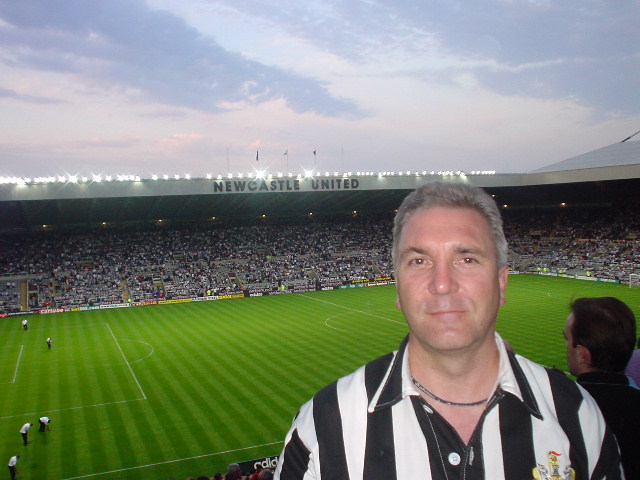
Note the glazed expression and vacant look about one who is once more at his personal Wailing Wall.
Since those early days I have been to what must be hundreds of football matches involving Newcastle United and listened to more on the radio. There are certain stand-outs in that time span, most notably the last time the team was successful in a major competition--in season 1968-1969--when we lifted the Inter-Cities Fairs Cup, now better known as the UEFA Cup. At the start of the campaign none of the sporting pundits gave Newcastle a snowball’s chance in hell, but as the big names of Europe became scalps on our belts one by one, people began to sit up and take notice. Feyenoord, Sporting Lisbon, Real Zaragoza, Vitoria Setubal were dispatched and then came the mighty Glasgow Rangers in the semi-final. The second leg of this tie was played at St James’s Park after a goal-less draw at Ibrox on May 14th involving a penalty save by our keeper, Willie McFaul. I rose at 04.30 on Sunday May 18th when the tickets went on sale for the 2nd leg, to catch the first bus through to Newcastle, packed with like-minded devotees. The length of the queue outside the ground was a daunting sight but by 10 a.m. I had the precious slip of paper in my grasp, along with more than 60,000 others in the same frame of mind, and simply couldn’t wait for Wednesday night. For me and probably many others, the match was probably the most memorable of the whole campaign, but not for the football. It was a very tough, physical affair with no quarter given or expected but Newcastle managed to grab two goals in the 2nd half to win the game and put themselves into the final tie. The first goal came after 53 minutes--a high angled drive by Jim Scott in front of the home fans beating Neef all ends-up, after a killer through ball from Tommy Gibb. The second came 24 minutes later after an Ollie Burton free-kick to the head of Wyn Davies. A typical flick-on found Jackie Sinclair who cracked the ball into the roof of the net. Oh Joy O Bliss O Transport of Delight! A sea of black & white scarves hailed their conquering heroes and the din was unbelievable. We were in seventh heaven and loving it. However, the Rangers fans were not amused, to say the least. Maybe it was the fact that Scott and Sinclair were both Scots and had committed apostasy in their eyes or maybe it was the fact that they were to a man awash to the gunwales in drink, but they simply went berserk. From our position opposite in the Leazes, the Gallowgate resembled a rumbling volcano, erupting with blue-shirted two-legged lava hurling bottles and bricks and invading the pitch in an attempt to get the game abandoned. The referee stopped the match and took the players off for 17 minutes while the police fought back with horses and dogs to try and restore order. I was not yet 15 years old and it was and is the most fearful I have ever been at a football match. After the final whistle was blown, we had to get back to the bus stop while running battles were fought in the streets of Newcastle. After taking all the back routes we knew, I and half-a-dozen mates reached the haven (we thought) of the Pilgrim Street bus station. There was a double-decker in the sloping bay next to ours, with chocks under the front wheels and a few passengers on the top deck awaiting the driver and bus-conductor. It was going our way, but via Wrekenton, and we decided to wait for the next Middlesbrough bus as it would not be long, surely, and would get us home quicker. As we began to feel a little more secure, nervous chatter broke out, discussing the highlights of the game and wondering aloud who our final-tie opponents would be. And then we saw them, two brawny Jocks stripped to the waist, with blue scarves wrapped round both wrists, swaying as they passed a bottle of White Horse between them, swigging straight from the open neck. Raw fear began to overtake us again and we wondered which way to run. The bigger of the two Jocks finished the bottle and hurled it through a fire-station window and then hoisted himself up to the driver’s cab of the double-decker and released the hand-brake while his mate removed the wheel chocks. The bus rolled straight backwards and smashed into the back wall of the bus station, showering the screaming people inside with broken glass. The Jocks then wandered off, no doubt to try and get more drink from somewhere, totally ignoring we cowering, tim’rous beasties.
When I _finally_ got home that night somewhere around twelve, after my one and only experience of a genuine riot, one of the most terrifying nights of my life, my mother was furious. She had been watching the events on live TV. I was immediately forbidden to ever attend a football match again, it was simply too dangerous.
Well...
Two weeks later, I saw Newcastle beat the mighty Ujpesti Dosza of Budapest at St James’s park by three clear goals in the final tie first leg. After a further two weeks they triumphed in Hungary, after a few hiccups, to win the tie six-two on aggregate. Victory in Europe at the first attempt, surely we were going places now. Even the monumental landing on the moon by Apollo 11 a few weeks later, was small beer to a Newcastle fan. This was just the start.


Oh well...
Sometimes, going to a match is actually more enjoyable than being at the match. The putting on of the colours, the waiting for your transport to the ‘toon’, the pre-match banter over pies and pints of cask ale, the entrance to the ground and gasping at the first glimpse of the lush green sward, especially at the first match of the season are all part and parcel of the experience.


Nowadays, being resident in Japan most of the time, I only get to go to early season Newcastle games if at all, but I do enjoy following the matches live via Internet radio, for a small fee. I’m sure the day is not far off when a live video feed will be available, and that will be true progress.
Starting next Friday, June 9th, a different kind of madness ensues. Die-hard fans of deadly rival teams (even Newcastle/Sunderland, Spurs/Arsenal, Liverpool/Everton etc) put away their differences to follow the common cause--ENGLAND!
The wunderkind Wayne Rooney is unlikely to take part, but no matter. With this team, England have the best chance of the last forty years to win the World Cup.

Don’t let us down boys. England Expects That Every Man Will Do His Duty!

Sunday, May 21, 2006

The Motorcycle Diaries, Part II

Foreword:
There is a welcome late-Spring holiday period in Japan known as ‘Golden Week’ when four national holidays fall close to each other and most companies allow their staff to take the intervening periods as paid vacation. This period is usually marked by a national collective surge of dromomania when everyone seems to be on the move somewhere. Airline and train reservations are made months in advance for travel to foreign climes or other exotic destinations which means the experience is usually horrendously jam-packed. I once experienced this ‘Golden Weakness’ at first-hand on an Inland Sea ferry from Matsuyama to Kobe. There were so many people on board that conditions resembled those on an 18th century slaver en route from Guinea to New Orleans, and I had the distinct feeling that the vessel would capsize at any moment. To make matters worse it rained in Kobe for 72 hours straight and the return journey was just as bad, if not worse. Once bitten--twice shy, and nowadays I usually stay at home in Golden Week and leave the rest of the madding crowd to do as it will. It’s a good time to get jobs done around the house as the round tuits miraculously become available at this time, and a good time to simply relax...
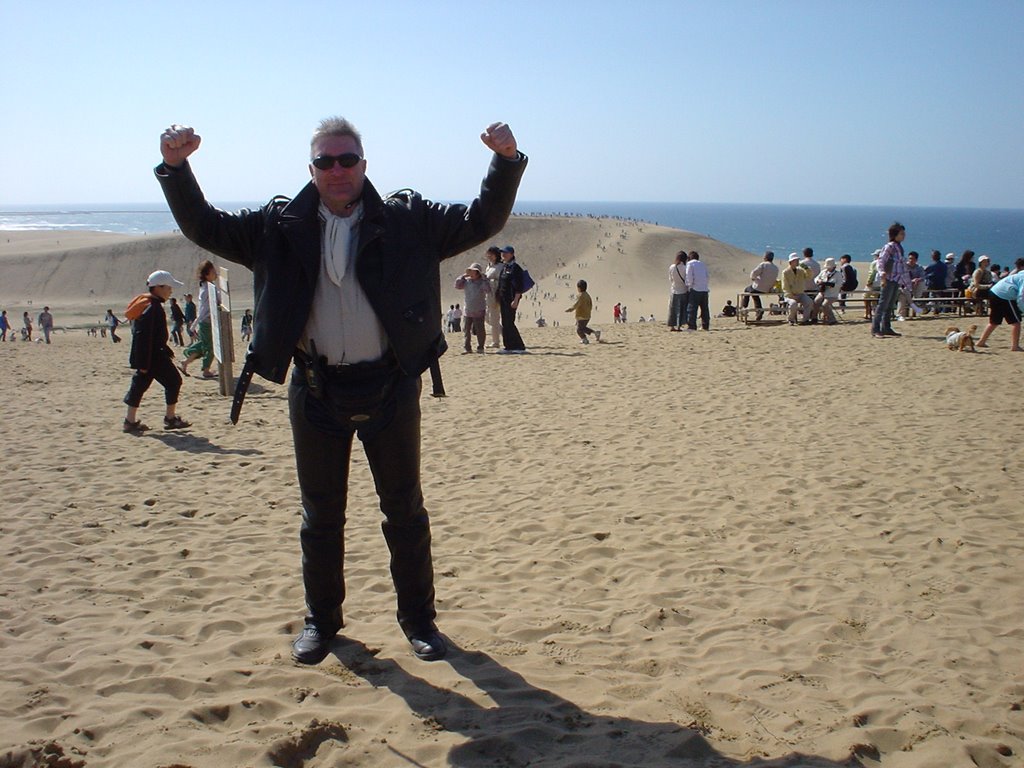
However, since I took up motorcycling again, I have usually taken an extended day-trip in Golden Week to some far-flung domestic place of interest. In 2005 I journeyed north to Amanohashidate,the ‘Standing Bridge of Heaven’ on the north coast of Kyoto prefecture together with my riding partner, Akira. This year we went in a similar direction but then headed westward to Tottori to see the famous coastal sand dune there. This journey was attempted In September 2005, but had to be abandoned half-way due to torrential rain. Bearing this in mind, we studied the weather charts most assiduously prior to our trip and postponed it once due to an outside chance of rain in central Hyogo. However, the forecast for the following day was fine and clear and so it was we set out at 07.45, in bright sunshine.

The Log: Wednesday May 3rd...
We head due west towards the town of Inami and cross the Kako river before heading north towards Kasai and then west again to the town of Kodera. At this place, ‘Fragrant Temple’, we are to join the Ban Tan highway which is a toll-route from Himeji to Wadayama and roughly bisects the prefecture south-north. It is a great time-saver, though somewhat expensive, and we have decided on it so as to make our journey feasible in one day.
Before joining the Ban Tan and its sustained high speeds, we stop at a Seven-Eleven 24-hour convenience store to fortify ourselves with caffeine. I check my fob-watch in the manner of Phileas Fogg--08.40. A timely break in the journey.
Canned coffee imbibed, we emerge from the store and go through the painstaking sequence of getting ready for riding. Stow wallet in marsupial pouch, fasten waist belt. Knot silk scarf, zip up jacket. Unzip jacket, retrieve ear plugs. Insert ear plugs, re-zip jacket. Take off sunglasses, place on seat. Fit leather face-mask, put on helmet. Open visor, put on sunglasses. Zip up jacket sleeves, put on gloves. Take off one glove, find keys in jacket side-pocket. Put glove back on, get on bike. Ease off main-stand, insert key & start engine. Elapsed time--about one minute.
It is a right faff getting ready for riding, but if I don’t do it just so I have to stop, sooner or later, and fiddle with something.
For some reason, Akira is always much faster than me at getting ready and is invariably waiting patiently, with his single-cylinder Yamaha thumping away rhythmically. I normally hear it burst into life after a single kick, with a harsh bellow from its megaphone exhaust cone at about the same time as I can’t find my keys. Today though, something is not quite right. The engine has not started and Akira is working up a bit of sweat as he belabours the kickstart lever. I notice a thin dribble from a drain-pipe forming a puddle below the engine and smell the sickly-sweet odour of fresh gasoline. The carburettor is flooding and he has to switch off to let the excess evaporate. This is a little disconcerting, but Akira, sanguine as ever, is not unduly troubled. As he is an engineer and knows more about such things than me, I put the worries away. About five minutes later, the Yamaha fires up first kick and we are away.
The clouds are huge and white between wide stretches of vivid blue sky and the morning is warming up fast. I begin to regret donning the face mask, but am glad I brought it along as the evening air will be cool. There is a fair amount of traffic on the Ban Tan but it is all moving at a fair clip. It mainly consists of large, spacious saloon cars, usually with a family ensconced. May 3rd is a national holiday, Constitution Day, and is followed by two more so most people are no doubt going to make a long weekend of it. There are no farmers in small white pick-up trucks, which I am thankful for. Abominable drivers to a man, these characters are invariably smoking a fag with the right hand while jabbering into a mobile phone in the left and specialise in sudden manoeuvres with zero use of the indicators. I generally avoid them like the plague and am gratified to note that that when I see one it is always on one of the country roads which run alongside the Ban Tan. The highway itself is a little unusual, in that it consists of a single lane in each direction which means overtaking is a risky business for a motorcycle and mostly impossible for a car. In days gone by the road was a turnpike, with toll gates at frequent intervals staffed by grey men with mournful expressions and hacking coughs. You seemed to be forever slowing down or pulling away. Nowadays the system is smoother, you pick up a card at the entry point and present it at the exit whereupon the required toll is flashed up on an illuminated display. The staff seem healthier too, maybe they smoke less or maybe the exhaust gas is cleaner than it once was.
Before very much longer we are at the northern limit of the Ban Tan, near the town of Wadayama. While we are paying the toll, Akira’s engine cuts out and I smell the gas again. The carburetion problem has not gone away, but it appears that it only manifests itself at idle as the engine has been performing happily at high rpm. Akira looks a little more worried now and decides to find a filling station in order to assess the extent of fuel loss. We do this in the town of Izushi after an unbelievable ride over a switchback mountain road. Akira has taken this diversion in order to avoid traffic in larger towns en route. Follower rather than leader now, I am pleased that to note that the Yamaha does not appear to be losing any more fuel, except at a standstill. In the broad valley of the Maruyama river, at a rural filling station we confirm that the leak is evident but not substantial and should not be a reason to abandon the trip. We are almost at the Sea of Japan, as far north as we got last time and we move on, hoping it is the best move. Gasoline prices are very high at present and it should really all go into the cylinder, not onto the road.
I have stopped checking my fob-watch every time we stop, and estimate time by the position of the sun in the sky. We have decided to visit the site of Genbudoh which is on our way, near the village of Akaseki in the district of Toyooka. The name literally means ‘Basalt Cavern’ and is a most spectacular sight with its hexagonal columnar jointing and contorted strata of igneous rock. It was formed about a million and a half years ago by an outpouring of lava which formed hexagonal crystals as it cooled.


According to the posted information, its three chambers run to an extent of seventy metres, though entry is forbidden. A million and a half years is a mere twinkling in geological time, but Japan is still a young country in those terms. Its most famous symbol, Mount Fuji, is merely a dormant volcano and is widely expected to erupt again this century. The last time was a little over over two-hundred and six years ago. Frequent earthquakes, especially in Tokyo, remind us of the power beneath our feet. As I write, a slight tremor has rattled the windows and caused our Yorkshire Terriers to bark out a warning. In Japan, it is never far away...
Before we head on towards our next stop, we take a look at the small Genbudoh museum and gift shop. There is a most impressive selection of lapidary and fossils, but the thing that catches my eye is a marker up near the ceiling, higher than I can reach. It indicates the floodwater level reached after the archipelago was ravaged by typhoons in 2004. Fully ten of them made landfall on mainland Honshu that year, but this area took a particular clattering. It is a sobering thought, on such a fine and sunny day...
Akira gets the Yamaha going first kick, which is reassuring. His machine must be all of twenty years old now, a single-cylinder SRX 600, described by the motoring correspondent in the Daily Telegraph as ‘the best British bike that the Japanese ever made’. Akira has owned it for about 18 months now and I have never seen him happier.


The last machine he owned, according to him, some fifteen years prior to this one, was a Kawasaki Z1300, an immense liquid-cooled behemoth with its six cylinder engine transverse across the frame. He tells me that it weighed around 350 kg dry and near half a ton when stocked with its vital fluids. It must feel a bit like swapping a bull elephant for a quarter-horse. The superior power-to-weight ratio of the Yamaha makes it quicker off the mark than my twin-cylinder Kawasaki W650, and it is usually not until we are past 60-70 kph that the extra horsepower shows itself and I can get past him, should I be so inclined. Today he leads the way and we move on down the picturesque wooded estuary of the Maruyama River on its approach to the town of Kinosaki, famous for its hot-springs and rugged coastline. Here there is a slight delay as there is a line of cars and buses awaiting admittance to ‘Marine Land’, a somewhat cheesy amusement park with performing dolphins, penguins and other non-native marine creatures for tourists to ooh and aah over. I remember that my two eldest children enjoyed themselves there about fifteen years ago.
Today we have our sights set further afield, and we are relieved to be clear of Kinosaki and on the coast road to Takeno, our next port of call. The road clings to rugged cliffs of dark igneous rock which the pounding sea has carved into fantastic shapes. I catch a whiff of the ocean’s salty tang and feel a sense of exhilaration. This is more like it. This is why we came this far.
We round a final curve with a precipitous overhang and catch sight of Nekosaki, a long promontory which is reckoned to resemble the profile of a crouching cat. This is the fishing port of Takeno with its wonderful bay and curving beach of gleaming white sand, which seems like an opportune location to stop for lunch. The sea front is quite crowded and we are quite fortunate to find a single parking space which will accommodate the motorcycles. There is some kind of festival procession in progress which explains the crowds.
Over lunch we discuss the Yamaha and its carburetion problem. I venture the possibility that it might be caused by the float chamber sticking due to accumulated gasoline residues and advise Akira to try and find some Redex petrol treatment. He has never heard of this product and I realise that it is a very long time since I have seen any. My old Morris Minor used to like it anyway, two shots in the filler neck once a month before filling the tank seemed to keep it quite happy and rolling around the streets of London. Maybe there is an ersatz Japanese equivalent available.
We go outside and record our visit on digital memory stick. It is very warm now and I am anxious to get back in the wind before the sweat begins to pour down my cheeks.


An urchin wants to know my name so I tell him it is ‘Terminator’ which seems to make him happy. We head west on Route 11, which later turns into Route 178, sometimes hugging the coast and little bays and at other times dodging behind headlands, all the time sharing the direction with a single track railway line, except when it dives into tunnels. It is an excellent road for motorcycles and what little traffic there is obligingly maintains a decent momentum. Eventually the San’in railway disappears from sight and we don’t see it again till we reach the town of Amarube. Here it crosses the road, far above us on an imposing trestle bridge built from iron. I recognize the structure and recall that it was the site of a horrendous train wreck in the late 1980s when a powerful gust of wind literally blew a 2-car train right off the bridge, to crash down on a small factory below killing several people. What an awful way to go...
The bridge was built in 1912 when the Taisho Emperor was on the Chrysanthemum Throne and Japan was on the up and up. It is a famous landmark and piece of industrial heritage, much beloved of train-spotters the world over.


However, the news is that the structure is due to be demolished and replaced by a modern pre-stressed concrete bridge, starting in August 2006 and to be completed by the end of the year. Maintenance of such a venerable structure is becoming too expensive and the new bridge will allow schedules to be maintained. There is little room for sentiment in today’s hard-nosed business world. The train service is sometimes suspended due to high winds (for obvious reasons) and this is inconvenient, as well as being a drain on revenue. The wind is light today, but I still have a nervous glance upwards as we pass under the bridge and continue on our way. Maybe it will be my last sight of the old Amarube bridge. Nothing is permanent but change...
Some time later on we cross the prefectural border into Tottori and I raise my fist in triumph. Finally made it here.
There is a bit of a hold-up as we wait to join Route 9, the main road from Wadayama, the Yamaha’s carburettor floods and the engine cuts out again. I can see from Akira’s body language that the novelty is beginning to wear off this little trait. However, it starts up again after a little while and we are soon gazing down at a vast expanse of sand--the Tottori Sakyuu.


It is easy to imagine one’s self in the Sahara Desert, especially with the camels for hire. Both the Arabian Dromedary and the Asian Bactrian type are available--at a steep asking price for a short ride. They even want 500 yen for a photograph of you beside the abominable creatures. At a distance of 20 metres I can still catch a whiff of their fetid breath and general stink and decide to pass on that one. My admiration for Lawrence of Arabia does not extend that far, thank you very much...
There are hordes of people here on this fine Bank holiday and we have a distinct advantage with 2-wheeled transport in that we can jump traffic queues and park where we like. A nice cup of Joe goes down well and then it’s time to look for souvenirs of the trip, light enough to carry on the pillion beneath the elastic mesh net. I am surprised to find pears on sale, thinking that they are out of season, but then I realize that nothing is ever out of season anymore, with modern vinyl hot-house farming. This is what I buy as these are the ‘expected’ souvenir from Tottori Sand Dune. Three of them for ¥1100, each about the same size as a 5kg shot, they just fit under the carrying net.
It is 15.30 and we have seen what we came to see so it’s on the road again. A short interlude at a self-service filling station while I work out how to operate the thing. The sun is shining directly behind me, making it tricky to decipher the digitized instructions. Eventually the gas tank swallows up ten litres of regular, for ¥1320. Not very much cheaper than a normal station with attendant service. I poke the otsuri button and my change appears in the form of a pre-paid card. The filling station is part of a nationwide chain, so it is a reasonable presumption that I can use the card at my local branch. We move on out on Highway 29, heading due south with the lowering sun on our right-hand.
As we head into the mountains, the glow of the sun and lengthening shadows give the landscape a surreal appearance. We are heading towards the To-kura Pass which will be another ‘first’ for me. The road winds ever higher up the valley and we see signs advertising ski-runs, which are out of season--thankfully. On two wheels in snow, this road would be a nightmare. The summit of the To-kura Pass is a neat double hairpin, reminiscent of the old Devil’s Elbow in Scotland, though considerably wider. It is somewhat cooler up here and I am glad of the face mask & silk scarf. Down the other side, just inside our home prefecture, we stop at a roadhouse near the mountain town of Haga. Fried chicken set goes down a treat, all the fresh air today has given us an appetite.
The sunglasses are put away for the final time today and we set off on the final stage of our journey. We have decided to avoid the city of Himeji and so the very last stage of the trip is the same as the first. We cross the Ban Tan highway at the town of Kodera and finally arrive home at 20.30. It has been thirteen hours and 440 kilometres--certainly the furthest I have ridden in a single day.

Afterword
Ecclesiastes 3.1 ‘To every thing there is a season, and a time to every purpose under the heaven’
We have discovered that the carburetion problem on the Yamaha can be alleviated temporarily by tapping on the float chamber. At first Akira was using a long crescent wrench for this, but now he uses a short rubber/nylon dual-faced hammer which I presented him with. This does not carry the risk of damaging the carburettor. I bought this tool about a year ago in a Daiso 100-yen shop, thinking ‘There must be something I can use this for’. Its purpose in the grand order of things has now been revealed...
The pre-paid card representing my change of ¥680 turned out to be usable only at that single filling station in Tottori. A neat little scam they have going there. Shame on you ENEOS Corporation...

TBC